Retail Scheduling: Complete Guide for 2026

Master retail scheduling with proven strategies. Learn how to optimize staff coverage, reduce costs, and improve employee satisfaction in 2026.
Managing workforce schedules in retail environments presents unique challenges that directly impact both operational efficiency and customer satisfaction. Retail scheduling requires balancing fluctuating customer demand, employee preferences, labor regulations, and budget constraints while maintaining adequate coverage during peak hours. As we navigate 2026, retailers face increasing pressure to optimize their scheduling practices amid labor shortages, rising wage costs, and evolving employee expectations for work-life balance.
Understanding the Complexity of Retail Scheduling
Retail scheduling encompasses far more than simply filling shifts on a calendar. It involves strategic workforce planning that accounts for seasonal variations, promotional events, inventory cycles, and customer traffic patterns.
The complexity stems from multiple variables that shift constantly. Customer foot traffic varies by day of week, time of day, and season. Employee availability changes due to personal commitments, educational schedules, and other jobs. Labor budgets fluctuate based on sales performance and corporate directives.
Key Components of Effective Retail Scheduling
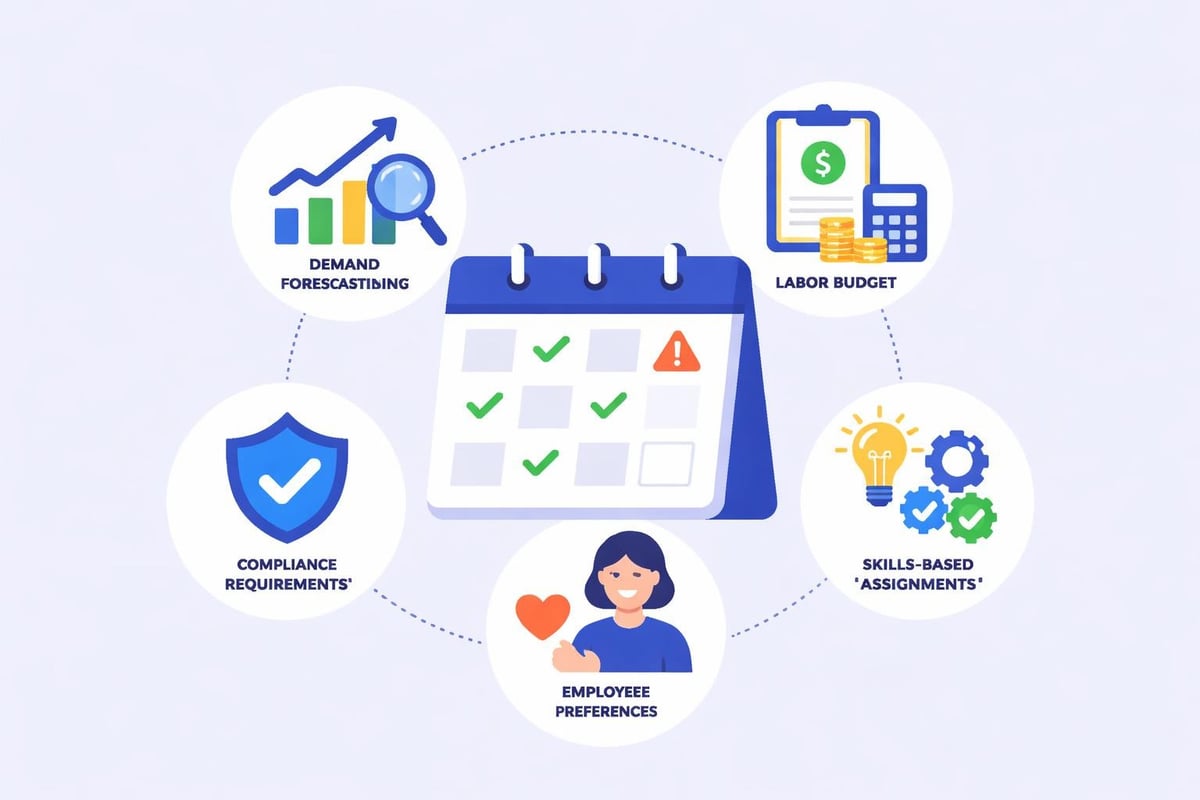
Several critical elements form the foundation of successful retail scheduling:
Demand forecasting based on historical sales data and traffic patterns
Labor budget management to control costs while maintaining service levels
Compliance tracking for labor laws, break requirements, and overtime regulations
Employee preference consideration to improve retention and satisfaction
Skills mapping to ensure qualified staff coverage in specialized departments
According to research on retail workforce management, 68% of retailers cite scheduling as a top workforce management challenge in 2026.
Building Your Retail Scheduling Foundation
Before creating individual schedules, retailers must establish clear scheduling policies and gather essential data. This groundwork prevents conflicts and creates consistency across your organization.
Determining Optimal Coverage Requirements
Calculate your coverage needs by analyzing point-of-sale data, customer traffic counts, and transaction volumes. Identify your busiest hours, days, and seasons to allocate staff appropriately.
Compare your actual labor hours against sales performance to establish baseline staffing ratios. Most retailers target labor costs between 10-15% of sales, though this varies by retail segment and location.
The best practices from When I Work emphasize starting with coverage needs before considering individual preferences, ensuring business requirements take priority.
Creating Skills Inventories and Role Definitions
Document which employees possess specific skills, certifications, or training. Track who can operate registers, handle returns, manage opening or closing procedures, or work in specialized departments.
Role Category | Required Skills | Scheduling Priority |
|---|---|---|
Store Manager | All operations, keys, deposits | High (coverage gaps critical) |
Department Lead | Specialized product knowledge | Medium (specific department coverage) |
Sales Associate | Customer service, POS system | Flexible (general coverage) |
Stock Associate | Inventory systems, lifting | Medium (receiving schedules) |
This inventory enables you to schedule qualified staff for specific positions rather than creating coverage gaps when specialized skills are needed.
Implementing Strategic Scheduling Practices
With your foundation established, implement scheduling strategies that balance business needs with employee satisfaction. These practices reduce conflicts, improve morale, and streamline the scheduling process.
Publishing Schedules in Advance
Provide schedules at least two weeks ahead whenever possible. Early publication allows employees to plan personal commitments, request necessary changes, and arrange childcare or transportation.
Research on modern workforce management shows that advance scheduling improves employee engagement by 34% and reduces last-minute callouts.
Advanced notice also benefits management by allowing time to address coverage gaps before the work week begins. When issues arise, you have options beyond emergency staffing or mandatory overtime.
Honoring Employee Preferences and Availability
Collect employee availability through standardized forms or digital platforms. Request time-off in advance, preferred shifts, and scheduling constraints like school schedules or second jobs.
While business needs take priority, honoring employee preferences whenever possible significantly impacts retention. Scheduling practices that prioritize staff needs create a positive work environment and reduce turnover costs.
Consider these preference management strategies:
Establish clear deadlines for availability submissions
Create a fair rotation system for desirable shifts
Balance unpopular shifts (early mornings, late nights) across staff
Track preference accommodations to ensure equity
Communicate when business needs override preferences
Leveraging Technology for Retail Scheduling
Manual scheduling using spreadsheets or paper systems cannot efficiently manage the complexity of modern retail operations. Digital scheduling platforms automate calculations, ensure compliance, and facilitate communication.
Benefits of Automated Scheduling Systems
Modern scheduling software transforms time-consuming administrative tasks into streamlined processes. These platforms integrate with point-of-sale systems, payroll software, and time tracking solutions.
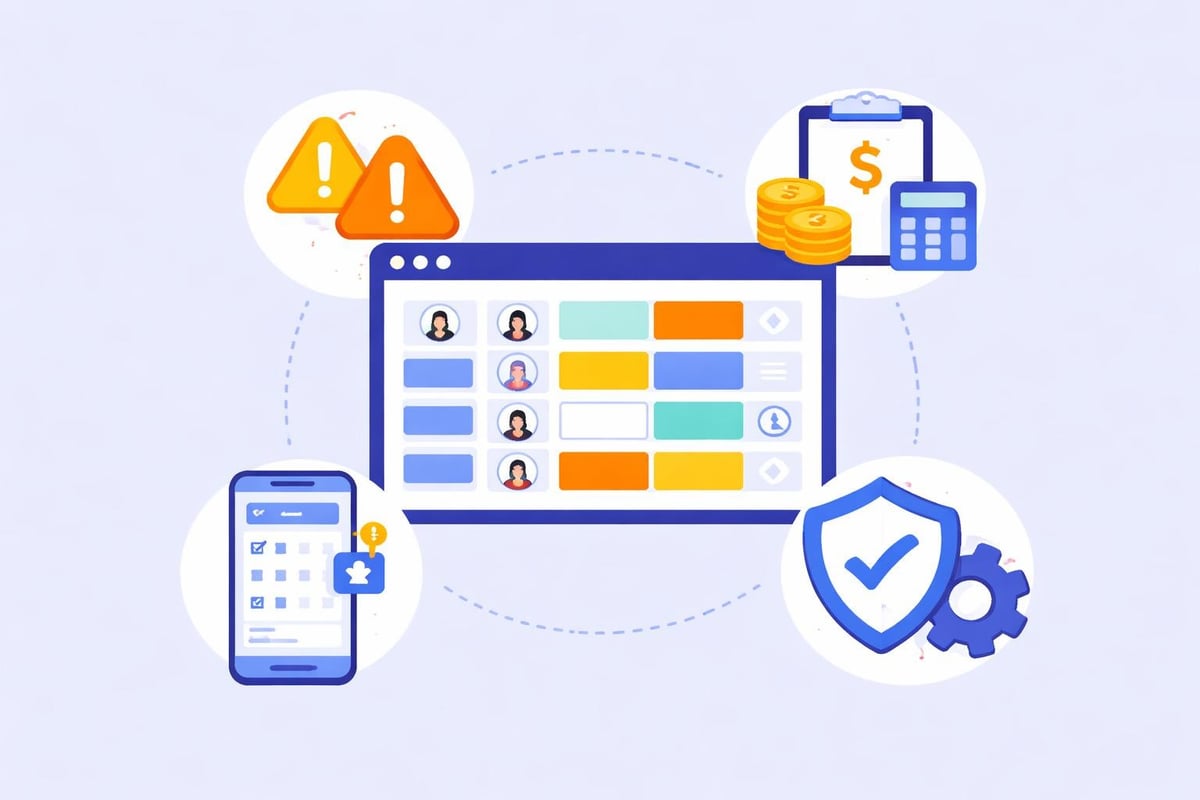
Key automation capabilities include:
Automatic conflict detection for double-bookings or availability violations
Labor cost calculations in real-time as schedules are built
Overtime alerts when employees approach threshold hours
Mobile access for employees to view schedules and request changes
Shift swap facilitation with manager approval workflows
For restaurants and service businesses, scheduling solutions for restaurants address industry-specific challenges like variable customer volumes and tip-based compensation.
Integrating Time Tracking with Scheduling
Connect your scheduling system with time tracking to compare planned versus actual hours. This integration reveals patterns like chronic tardiness, frequent early departures, or unauthorized overtime.
Real-time tracking also enables dynamic schedule adjustments. When an employee calls out, managers can immediately see who's available, qualified, and within budget to cover the shift.
Understanding labor costs for restaurants and retail businesses helps managers make informed decisions when unexpected scheduling changes occur.
Optimizing Labor Costs Through Smart Scheduling
Retail scheduling directly impacts your bottom line through labor cost management. Strategic scheduling reduces unnecessary expenses while maintaining service quality.
Aligning Schedules with Demand Curves
Match your staffing levels to customer traffic patterns rather than using fixed schedules. Analyze transaction data by hour to identify exactly when you need maximum coverage.
Many retailers overstaffed during slow periods and understaffed during rushes because they relied on traditional shift blocks. Data-driven scheduling eliminates this inefficiency.
Time Period | Average Transactions/Hour | Optimal Staff Count | Common Staffing Error |
|---|---|---|---|
6am-9am | 15 | 2-3 | Overstaffing opening procedures |
12pm-2pm | 48 | 6-7 | Understaffing lunch rush |
3pm-5pm | 22 | 3-4 | Maintaining lunch levels |
6pm-8pm | 35 | 5-6 | Early reduction before evening peak |
Controlling Overtime and Scheduling Costs
Monitor weekly hours throughout the scheduling period to prevent unintentional overtime. Most scheduling software provides alerts when employees approach 40 hours or your organization's overtime threshold.
Insights into retail workforce management highlight that reducing unplanned overtime by just 2% can significantly impact annual labor budgets.
Consider these overtime prevention tactics:
Set scheduling software limits that prevent assigning hours beyond thresholds
Maintain a pool of part-time employees for flexible coverage
Cross-train staff to fill specialized roles without requiring specific individuals
Review schedules mid-week to identify potential overtime situations
Establish approval processes for overtime before it occurs
Managing Schedule Changes and Communication
Even perfectly planned schedules require adjustments. Effective change management processes minimize disruption and maintain employee trust.
Establishing Clear Change Protocols
Define who can make schedule changes, under what circumstances, and with what approval requirements. Document these policies in your employee handbook and review during onboarding.
Common change categories include:
Employee-initiated swaps: Staff arrange coverage with qualified colleagues, manager approves
Manager-initiated changes: Business needs require modifications, affected employees receive notice
Emergency callouts: Last-minute absences trigger immediate coverage procedures
Availability updates: Employees submit changes within deadline parameters
Transparent protocols prevent favoritism accusations and ensure consistent treatment across your workforce.
Leveraging Mobile Communication Tools
Mobile apps enable instant schedule distribution and change notifications. Employees receive push notifications about new schedules, approved swaps, or schedule modifications.
This immediate communication eliminates excuses about missed schedule updates. Digital confirmations provide documentation that employees received and acknowledged schedule information.
The best practices outlined by Agendrix include using color coding and visual cues in scheduling interfaces to improve clarity and reduce confusion.
Addressing Common Retail Scheduling Challenges
Retail environments present unique scheduling obstacles that require specialized strategies and solutions.
Managing Part-Time and Seasonal Workforce Fluctuations
Many retailers rely heavily on part-time employees and seasonal workers during peak periods. This workforce composition complicates scheduling through:
Constantly changing availability as students adjust class schedules
Variable weekly hour requests from employees balancing multiple jobs
Temporary seasonal workers unfamiliar with systems and procedures
High turnover requiring frequent onboarding of new schedulable employees
Maintain detailed availability records and build schedules that accommodate fluctuating hour requirements. Create training schedules that rapidly prepare seasonal workers for their roles.

Ensuring Compliance with Scheduling Regulations
Labor laws governing retail scheduling have expanded significantly. Many jurisdictions now require:
Predictive scheduling with specific advance notice requirements
Premium pay for schedule changes within protected windows
Minimum rest periods between shifts
Good-faith estimates of work schedules for new hires
Preferential access to additional hours for existing part-time staff before new hiring
Non-compliance carries substantial penalties. A stochastic optimization approach to workforce management demonstrates how sophisticated planning can address both demand uncertainty and regulatory constraints.
Automated scheduling systems track these requirements and prevent violations before schedules are published. Manual tracking becomes nearly impossible as regulations increase in complexity.
Building Employee Engagement Through Scheduling
Your scheduling practices significantly influence employee satisfaction, retention, and performance. Fair, consistent scheduling demonstrates respect for your workforce.
Creating Predictable Schedule Patterns
While complete schedule consistency may be impossible in retail, establishing predictable patterns reduces employee stress. Consider:
Rotating weekend requirements fairly across staff
Assigning consistent shift times (same employee always opens Tuesdays)
Publishing schedules on the same day each week
Maintaining minimum hours guarantees for part-time staff
Limiting "clopening" shifts where employees close then open the next morning
These practices enable employees to establish routines, maintain second jobs, attend classes, or manage family responsibilities.
Implementing Fair Shift Distribution
Track shift distribution metrics to ensure equitable treatment. Monitor who receives preferred shifts, undesirable shifts, holiday assignments, and total hours.
Transparency in shift allocation builds trust. When employees understand the rotation system and see fair application, complaints about favoritism decrease substantially.
Shift Distribution Metric | Target Range | Review Frequency |
|---|---|---|
Weekend shifts per employee | Equal ±10% | Monthly |
Opening shifts per employee | Equal ±15% | Monthly |
Holiday shifts per employee | Equal rotation | Annually |
Prime selling hours | Performance-based distribution | Quarterly |
Performance-based scheduling rewards top performers with preferred shifts while maintaining baseline fairness for all employees.
Measuring Scheduling Effectiveness
Track key performance indicators to evaluate and improve your retail scheduling processes continuously.
Essential Scheduling Metrics
Monitor these metrics to assess scheduling quality:
Labor cost percentage: Total labor costs divided by sales revenue
Schedule adherence: Actual hours worked versus scheduled hours
Overtime percentage: Overtime hours as percentage of total hours
Schedule change frequency: Number of modifications after initial publication
Coverage gaps: Incidents of unstaffed positions during operating hours
Employee satisfaction scores: Survey results regarding scheduling fairness
Establish baseline measurements, then track trends over time. Significant deviations signal problems requiring investigation.
Analyzing Schedule Performance Data
Review scheduling data alongside operational metrics to identify correlations. Compare labor hours against customer satisfaction scores, sales conversion rates, and average transaction values.
This analysis reveals whether understaffing harms customer experience or whether overstaffing fails to generate proportional revenue increases. Data-driven decisions replace assumptions about optimal staffing levels.
Regular schedule performance reviews also identify top-performing managers who consistently balance costs, coverage, and employee satisfaction. Document their practices for organization-wide implementation.
Advanced Retail Scheduling Strategies
Once you've mastered fundamental scheduling practices, implement advanced techniques that provide competitive advantages.
Implementing Skills-Based Optimization
Beyond basic qualification tracking, advanced scheduling considers employee proficiency levels. Schedule your most skilled associates during peak customer traffic when expert assistance drives sales.
Pair experienced employees with trainees during moderate traffic periods, maximizing development opportunities without sacrificing service quality during rushes.
Creating Dynamic Scheduling Models
Traditional static schedules cannot adapt to real-time conditions. Dynamic scheduling adjusts staffing based on actual conditions rather than historical averages.
When weather, events, or unexpected situations impact customer traffic, dynamic systems recommend schedule modifications. Managers receive alerts to call in additional staff or send employees home early.
This agility prevents labor waste during unexpectedly slow periods and coverage gaps during unexpected rushes. The approach requires mobile communication tools and willing employees available for on-call shifts.
Building Strategic Labor Pools
Develop relationships with reliable temporary or on-call workers who supplement your core team during peak periods. These strategic pools provide scheduling flexibility without permanent payroll increases.
Maintain these relationships through:
Regular communication even during slow periods
Fair compensation for on-call availability
Preferential consideration for permanent positions
Consistent scheduling when they work
Professional treatment equivalent to regular staff
Quality on-call pools function as insurance against callouts, unexpected demand, and seasonal surges.
Effective retail scheduling balances complex operational requirements with employee needs, creating sustainable workforce management that drives both profitability and satisfaction. By implementing structured processes, leveraging technology, and continuously measuring performance, retailers can transform scheduling from an administrative burden into a strategic advantage. Heybegin provides smart scheduling solutions specifically designed for service industries, offering real-time tracking, automated compliance, and mobile accessibility that streamlines workforce management while reducing labor costs. Whether you manage a single location or multiple sites, the right scheduling platform transforms how you plan, communicate, and optimize your most valuable resource.